The Scottish rules on ventilation, damp and mould.
England has Awaab’s Law and Part F. Scotland has its own Awaab’s Law regulations, its own housing standards and its own Building Standards. This page sets out what applies north of the border — in plain English.
Investigation and Commencement of Repair (Scotland) Regulations 2026
Made under the Housing (Scotland) Acts 2001 and 2006 and in force from 6 October 2026, the Regulations set statutory timescales for responding to damp and mould in private tenancies, Scottish secure tenancies and short Scottish secure tenancies. Working days exclude weekends and Scottish bank holidays.
Three standards, one thread: ventilation.
Tolerable Standard
Housing (Scotland) Act 1987, s.86. A house must be structurally stable, substantially free from rising or penetrating damp, and have satisfactory provision for natural and artificial lighting, ventilation and heating. Below the Tolerable Standard means unfit to live in.
Repairing Standard
Housing (Scotland) Act 2006, s.13, with statutory guidance updated in 2024. Wind- and water-tight, reasonably fit for human habitation, and installations for ventilation in reasonable repair and proper working order. Enforced by the First-tier Tribunal (Housing and Property Chamber).
SHQS & the Charter
The Scottish Housing Quality Standard requires homes to meet the Tolerable Standard and be free from serious disrepair. The Scottish Social Housing Charter, with technical guidance updated in January 2026, is what the Scottish Housing Regulator measures landlords against — damp and mould included.
Technical Handbook — Section 3.14 Ventilation
Scotland’s equivalent of Part F. Standard 3.14 requires every building to be ventilated “so that the air quality inside the building is not a threat to the building or the health of the occupants”. The Domestic Handbook then sets the figures we test against.
| Space | Extract rate |
|---|---|
| Kitchen | 30 l/s adjacent to hob · 60 l/s elsewhere |
| Utility room | 30 l/s |
| Bathroom / shower room | 15 l/s |
| Toilet | 3 ach (air changes per hour) |
| Space | Base | Boost |
|---|---|---|
| Kitchen | 6 l/s | 13 l/s |
| Utility room | 4 l/s | 8 l/s |
| Bathroom | 4 l/s | 8 l/s |
| Toilet | 3 l/s | 6 l/s |
| Item | Provision |
|---|---|
| Trickle ventilator — apartments | 12,000 mm² |
| Trickle ventilator — kitchens, utility, bathrooms, WCs | 10,000 mm² (double if ducted) |
| Infiltration 5–10 m³/h/m² @ 50 Pa | Standard trickle ventilation acceptable |
| Infiltration below 5 m³/h/m² @ 50 Pa | Mechanical ventilation required — MVHR, MEV or dMEV |
| Infiltration below 15 m³/h/m² @ 50 Pa | CO₂ monitor in the principal bedroom |
Figures from the Building Standards Technical Handbook 2022 – Domestic, Section 3.14. Non-domestic buildings are covered by the Non-domestic Handbook, Section 3.14.
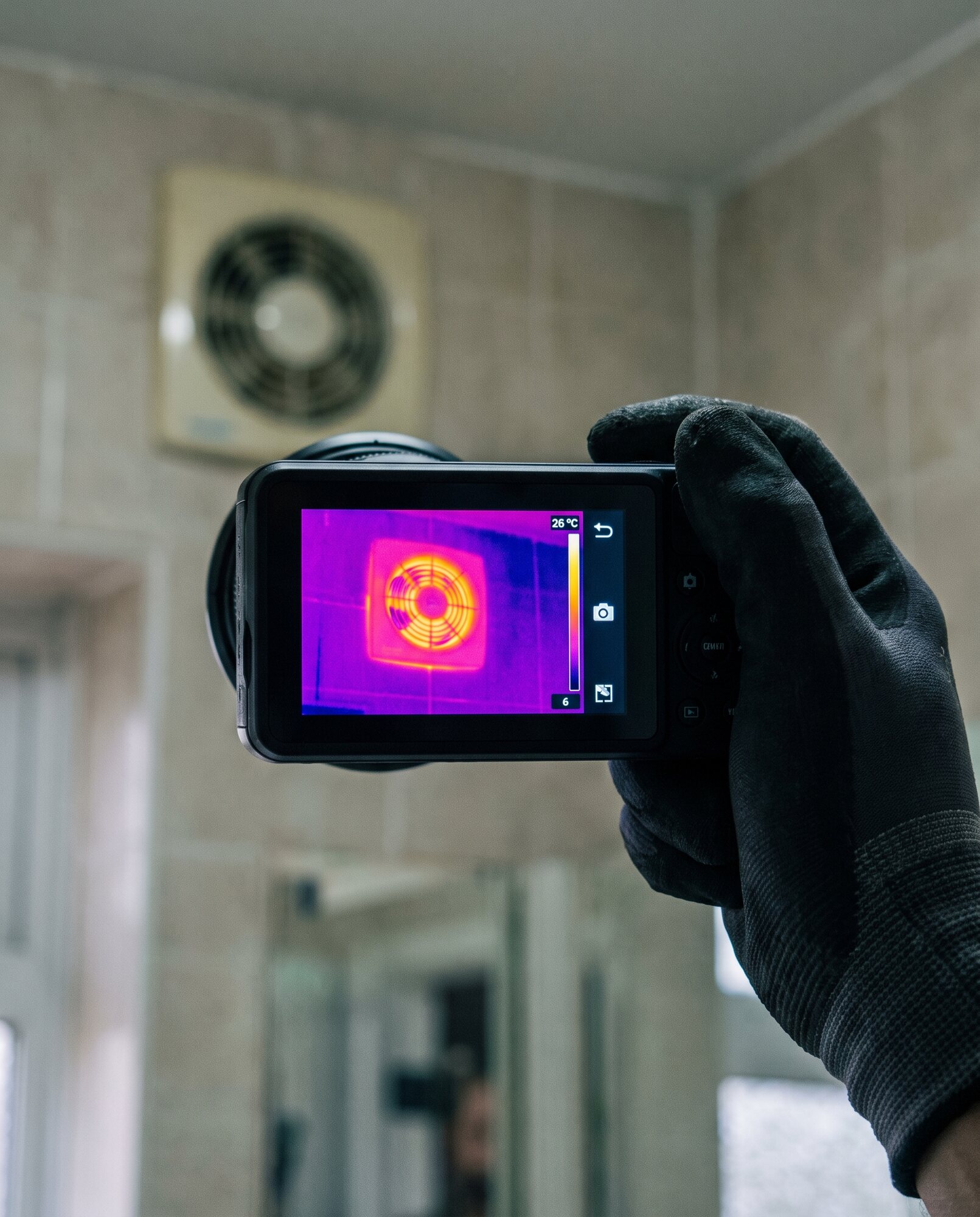 Extract fan · thermal check
The rest of the toolkit.
Workplace (Health, Safety and Welfare) Regulations 1992 — Regulation 6
Applies across Great Britain. Every enclosed workplace must be ventilated by a sufficient quantity of fresh or purified air. HSE’s Approved Code of Practice (L24) treats 5–8 litres per second per occupant as a reasonable fresh-air supply, with more where there are pollutants or high occupancy.
BS 5250 — Management of moisture in buildings
The British Standard code of practice on condensation and moisture control. It links heating, insulation, occupancy and ventilation and is the reference we use to explain why a home is condensing and what balance of measures will stop it.
PAS 2035 — Retrofitting dwellings for energy efficiency
The specification behind publicly funded retrofit across the UK, including Scottish programmes. It requires a ventilation assessment before insulation works and sets out when ventilation must be upgraded to avoid creating condensation and mould.
BS EN 16798-1 and CIBSE guidance
Define indoor environmental categories for offices and other non-residential buildings, including CO₂ concentrations above outdoor levels and fresh-air rates per person. CIBSE Guide A and TM40 add the practical design and wellbeing guidance we reference in commercial reports.
Awaab’s Law and Part F in England — how Scotland differs
England’s Awaab’s Law (under the Social Housing (Regulation) Act 2023) applies to social landlords in England from 27 October 2025, and Approved Document F governs ventilation in England. Neither applies in Scotland. Scotland’s Regulations cover private as well as social tenancies, and Section 3.14 of the Technical Handbooks replaces Part F. If your stock straddles the border, we can report to both.
This page is general guidance to help landlords and building managers understand the framework. It is not legal advice; check the current legislation and take professional advice on your own circumstances.